
- Quarry Dust Malaysia – Debu Kuari for Construction, Filling & Bedding Works
- 🪨 What Is Quarry Dust (Debu Kuari)?
- 📋 Quarry Dust Product Specifications
- ✅ Key Features & Benefits of Quarry Dust
- ⚖️ Quarry Dust vs Crusher Run vs Sand – What's the Difference?
- 📐 How Much Quarry Dust Do You Need?
- 🛒 What Should You Check Before Ordering Quarry Dust?
- ❓ Frequently Asked Questions – Quarry Dust Malaysia
- 📲 Looking for Quarry Dust Supplier in Kuala Lumpur?
Quarry Dust Malaysia – Debu Kuari for Construction, Filling & Bedding Works
Looking for Quarry Dust (Debu Kuari) in Kuala Lumpur for your construction, renovation or site preparation project?
Quarry dust is a fine crushed-stone material commonly used in selected filling, levelling, bedding and construction applications. Whether you are preparing an outdoor area, working on a renovation project or arranging materials for a construction site, choosing the right aggregate can make a difference to the quality of your work.
One question we often hear from construction-material buyers is: “Can I use quarry dust instead of sand or crusher run?”
The answer depends on what you are building. Although quarry dust is useful for many applications, it is not a direct replacement for every type of sand, aggregate or road-base material.
At Buildmate Home Living Sdn Bhd, customers can enquire about quarry dust requirements for projects in Kuala Lumpur and surrounding areas. Tell us what you are working on, how much material you need and where your site is located so we can help you check the appropriate supply and quotation options.
🪨 What Is Quarry Dust (Debu Kuari)?
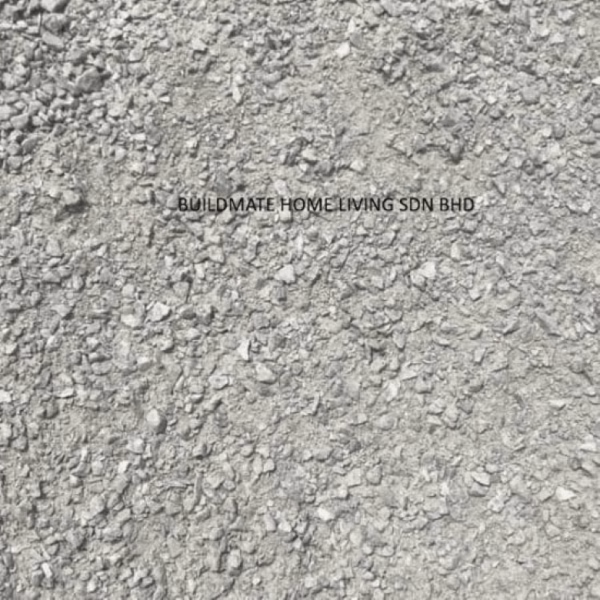
Quarry dust, sometimes called crusher dust, stone dust or habuk batu, is a fine aggregate material produced during the crushing and screening of rock at a quarry.
When larger rocks are processed into construction aggregates, smaller crushed-rock particles are also produced. These fine particles may be collected as quarry dust.
Unlike crusher run, which typically contains a mixture of coarse and fine aggregates, quarry dust mainly consists of smaller particles.
Its characteristics make it useful for certain construction applications where fine material is required. However, its particle size, grading, moisture content and compaction behaviour can vary depending on the quarry and production process.
This is why contractors should always check the material specification rather than choosing quarry dust based on its name alone.
📋 Quarry Dust Product Specifications
| Product details | Description |
|---|---|
| Product name | Quarry Dust |
| Malay name | Debu Kuari |
| Other names | Crusher Dust, Stone Dust, Habuk Batu |
| Material type | Fine crushed-rock aggregate |
| Source | Quarry rock-crushing and screening process |
| Appearance | Fine granular crushed-stone particles |
| Colour | Varies depending on the source rock |
| Particle size | Depends on the quarry’s grading and screening |
| Common uses | Selected filling, bedding, levelling and construction mixtures |
| Supply | Bulk material, subject to confirmation |
| Order unit | Confirm whether quoted by tonne, cubic metre or load |
| Delivery | Subject to quantity, location and transport arrangements |
| Price | Contact us for the latest quotation |
Product note: Exact grading, rock type, moisture content, current stock and delivery arrangements are not verified here. Please confirm the required specification before placing an order.
✅ Key Features & Benefits of Quarry Dust
1. Fine Crushed-Stone Material
Quarry dust contains small crushed-rock particles, making it useful in applications where a finer aggregate is needed.
Its texture differs from larger stones such as 3/4-inch aggregate and mixed-size materials such as crusher run.
2. Suitable for Selected Filling Works
Quarry dust may be used for certain filling and levelling applications, depending on the project requirements.
For example, a contractor may consider quarry dust when preparing a designated area before the next stage of construction.
However, for structural filling or areas carrying significant loads, the material must meet the engineer’s specified requirements.
3. Can Be Used in Certain Bedding Applications
Some construction systems permit fine crushed-stone material for bedding or surface preparation.
This may include selected paving and utility installation works. The actual suitability depends on the required particle grading, drainage and installation method.
4. Can Be Compacted Under Suitable Conditions
With the correct moisture level and compaction method, quarry dust may form a relatively firm layer.
The result depends on the material grading, layer thickness, ground conditions and equipment used. Quarry dust should not automatically be treated as an approved structural base.
5. Useful in Selected Construction Mixtures
Quarry dust may be incorporated into certain concrete blocks, paving products and cement-based mixtures when the mix design allows it.
It should not be substituted for natural sand without checking the required material properties and finished-product performance.
⚖️ Quarry Dust vs Crusher Run vs Sand – What’s the Difference?
If you are buying construction materials for the first time, these three products may look similar. However, they serve different purposes.
| Material | Characteristics | Typical applications |
|---|---|---|
| Quarry Dust | Fine particles produced from crushed rock | Selected filling, bedding and construction mixtures |
| Crusher Run | Combination of coarse and fine crushed aggregates | Road base, driveway base and compacted sub-base |
| Coarse Sand | Granular sand with grading dependent on its source | Concrete, mortar and specified construction works |
| Manufactured Sand (M-Sand) | Processed crushed-rock sand with controlled grading | Selected concrete and mortar applications |
Which one should you choose?
For driveway base preparation, crusher run is commonly considered because it contains a combination of aggregate sizes. For certain bedding or filling works, quarry dust may be an option if the project specification permits it.
For concrete and mortar, the correct sand or manufactured aggregate must meet the required grading and mix design. Research shows that quarry dust can be used in some cement-based mixtures, but performance depends on the replacement proportion and material properties.
📐 How Much Quarry Dust Do You Need?
Before ordering, it helps to calculate the approximate quantity required for your project.
Use this simple formula:
Length (m) × Width (m) × Finished thickness (m) = Volume (m³)
🛒 What Should You Check Before Ordering Quarry Dust?
When requesting a quotation, a little preparation can save time and help prevent ordering the wrong material.
Tell the supplier what you are building. Quarry dust for a general filling job may have different requirements from material intended for a concrete mixture or specified bedding layer.
Estimate your quantity. Share the dimensions of your working area or the required tonnage if it has already been calculated by your contractor.
Confirm the material specification. If your project has an engineer’s drawing, bill of quantities or material requirements, provide those details before ordering.
Check site access. Bulk material deliveries may require suitable road access and space for unloading. Confirm whether the site can accommodate the proposed delivery vehicle.
Ask about current pricing and availability. Quarry dust prices may change depending on the source, transport distance and order quantity.
❓ Frequently Asked Questions – Quarry Dust Malaysia
1. What is quarry dust used for in construction?
Quarry dust is used for selected filling, bedding, levelling and construction-mixture applications. It is also studied and used as a fine aggregate component in certain concrete and mortar products. The material must meet the specification for its intended use.
2. What is quarry dust called in Malay?
Quarry dust is commonly called Debu Kuari or Habuk Batu in Malaysia. Some suppliers also use the English terms crusher dust or stone dust.
3. Is quarry dust the same as crusher run?
No. Quarry dust mainly contains fine crushed-rock particles, while crusher run is a mixture of coarse and fine aggregates. Crusher run is commonly used for compacted road and driveway bases, whereas quarry dust is considered for applications requiring finer material.
4. Can quarry dust be used for land filling?
Quarry dust may be suitable for certain filling works, but it should not automatically be used for every type of land filling. The required material depends on soil conditions, drainage, loading and the project’s compaction specification.
5. Is quarry dust suitable for interlocking pavers?
Some paving systems may permit fine crushed-rock bedding, but others specify particular bedding sand. Always check the paving manufacturer’s installation requirements, especially where drainage and long-term surface stability are important.
6. Can quarry dust replace sand in concrete?
It can replace part of the fine aggregate in some properly designed concrete mixtures. However, its grading and fines content affect workability, water demand and performance. Laboratory research has found varying results depending on the material and replacement proportion. Do not substitute it without an approved mix design.
7. Is quarry dust cheaper than sand in Malaysia?
Sometimes, but not always. The final cost depends on the quarry source, quantity, delivery distance and market conditions. The best comparison is the delivered price for materials that meet the same project requirements.
8. How much does quarry dust cost per tonne in Malaysia?
There is no single fixed price. The quotation depends on the material source, required tonnage, delivery location and transport arrangements. Contact Buildmate with your project details to request current pricing.
9. How much quarry dust do I need for 100 square metres?
For a 100 m² area with a finished thickness of 50 mm, the geometric volume is 5 m³. The amount of loose quarry dust required may be higher after allowing for compaction, uneven ground and wastage.
10. How many tonnes of quarry dust are in one cubic metre?
The weight of one cubic metre varies with rock type, grading, moisture and bulk density. Ask the supplier for the applicable density before converting cubic metres into tonnes.
11. Can quarry dust be compacted?
Yes, quarry dust can be compacted under suitable conditions. The final density and stability depend on moisture content, grading, equipment and the compaction method. Proper testing may be required for engineered applications.
12. Is quarry dust good for a driveway?
Quarry dust may be used as a component in a suitable driveway construction system, but it is not automatically a replacement for crusher run or a designed road-base layer. The correct materials depend on vehicle loads, drainage and ground conditions.
13. Can quarry dust be used under a concrete floor?
Only if the floor design and construction specification permit it. The supporting layer must meet the required compaction, stability and moisture-control requirements. For structural floors, follow the engineer’s instructions.
14. Does quarry dust absorb water?
Its moisture behaviour depends on particle grading, mineral composition and compaction. Material with a high proportion of fine particles may restrict drainage. Quarry dust should not be assumed to work as a free-draining aggregate.
15. What is the difference between quarry dust and manufactured sand?
Manufactured sand is generally processed to meet a defined grading suitable for particular applications. Quarry dust is a finer by-product of rock crushing and may require additional processing before it meets the same specification.
16. Can quarry dust be used for pipe bedding?
It may be acceptable for some pipe installations if the material meets the manufacturer’s and engineer’s requirements. Bedding specifications vary depending on the pipe type, installation depth and surrounding soil.
17. Does quarry dust become hard after compaction?
Compacted quarry dust can become firm, but it does not turn into concrete simply through compaction. Its long-term performance depends on the material, moisture, support and environmental conditions.
18. Is quarry dust suitable for house renovation?
It may be useful for selected renovation applications, such as approved filling or bedding works. Ask your contractor to confirm whether quarry dust, sand, crusher run or another material is required for the specific job.
19. Where can I find a quarry dust supplier in Kuala Lumpur?
You can enquire with quarry aggregate suppliers and building-material businesses that handle bulk materials. Buildmate Home Living Sdn Bhd, based in Kuala Lumpur, can be contacted to check quarry dust enquiries, specifications, current availability and quotation options.
20. Can quarry dust be delivered to a construction site in KL or Selangor?
Delivery arrangements depend on the quantity, supplier availability, transport access and site location. Contact Buildmate with your delivery address and required quantity to confirm whether delivery can be arranged.
21. What information should I provide when ordering quarry dust?
Provide your project location, intended use, estimated quantity, required specification and preferred delivery date. If you have a drawing or bill of quantities, sharing it can help the supplier understand your requirements.
22. Is quarry dust the same as stone dust?
The terms are often used interchangeably, but products sold under these names can differ in particle grading and rock source. For technical applications, confirm the material specification rather than relying on the product name.
23. Is quarry dust suitable for concrete block manufacturing?
Quarry dust can be incorporated into some concrete block mixtures when the mix design has been tested. The correct proportion depends on particle grading, cement content, water demand and required block strength.
24. Can I order quarry dust in bulk for a construction project?
Bulk supply may be available depending on the supplier and required quantity. Confirm the selling unit, minimum order, material specification, price and transport arrangements before ordering.
📲 Looking for Quarry Dust Supplier in Kuala Lumpur?
Need Quarry Dust (Debu Kuari) for your construction, renovation, filling or site preparation work?
Whether you are arranging materials for a small renovation or a larger construction project, send us your required quantity and delivery location so we can check the available options.
Buildmate Home Living Sdn Bhd