

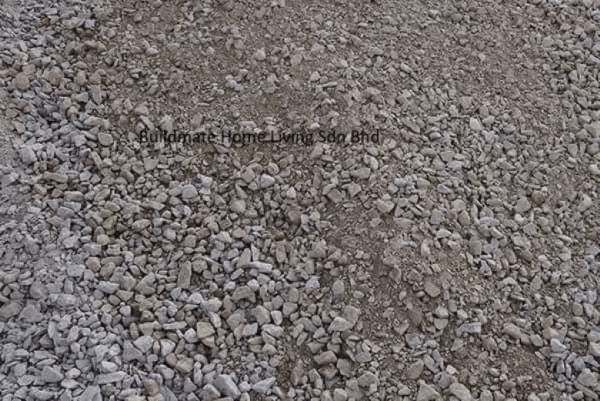
- 6 Tayar Crusher Run (Batu Campur) Malaysia – Road Base & Compacted Stone for Construction
- 🪨 What Is Crusher Run (Batu Campur)?
- 📋 Crusher Run (Batu Campur) Product Specifications
- ✅ Key Features & Benefits of Crusher Run
- 🏗️ Common Applications of Crusher Run (Batu Campur)
- ⚖️ Crusher Run vs Quarry Dust vs Aggregate 3/4" – What's the Difference?
- 📐 How Much Crusher Run Do You Need?
- 🛒 What Should You Check Before Buying Crusher Run?
- ❓ Frequently Asked Questions – Crusher Run (Batu Campur) Malaysia
- 📲 Looking for Crusher Run (Batu Campur) Supplier in Kuala Lumpur?
6 Tayar Crusher Run (Batu Campur) Malaysia – Road Base & Compacted Stone for Construction
Looking for 6 Tayar Crusher Run (Batu Campur) in Kuala Lumpur for driveway construction, road base, house renovation, site preparation or general earthworks?
Crusher run is a commonly used crushed-stone material in construction projects that require a compacted aggregate layer. It typically contains a mixture of larger crushed stones and smaller particles, including fines, which help the material pack together during compaction.
In Malaysia, contractors may refer to crusher run as Batu Campur, Crusher Run Stone, Crushed Aggregate Base or simply Crusher Run.
Whether you are preparing a driveway for a new house, working on a road construction project or levelling a construction site, choosing the correct crusher run grading and compaction method is important.
One question customers often ask is: “Is crusher run the same as quarry dust or Aggregate 3/4″?”
The answer is no. Although these materials are produced from crushed rock, their particle-size distribution and typical construction applications are different.
At Buildmate Home Living Sdn Bhd, customers can enquire about Crusher Run (Batu Campur) for construction and renovation projects in Kuala Lumpur and surrounding areas.
Tell us your required quantity, intended application and delivery location so we can help you check the available material and quotation options.
🪨 What Is Crusher Run (Batu Campur)?
Crusher run is a graded crushed-rock material containing a mixture of coarse aggregate and smaller particles.
It is commonly produced by crushing and screening quarry rock to create an aggregate blend suitable for selected base and sub-base applications.
Unlike single-sized aggregates such as Batu Tiga Suku (3/4″ Aggregate), crusher run contains a wider range of particle sizes.
The larger stones form part of the aggregate structure, while the smaller particles help fill spaces between them.
When crusher run is properly graded, placed at a suitable moisture content and compacted using appropriate equipment, it can form a relatively dense and stable layer.
This makes it commonly used for road base, driveway preparation and other construction applications where compacted granular material is required.
However, not every crusher run product meets the same grading or engineering standard.
For road construction, structural ground preparation or other specified works, the material must meet the project requirements.
📋 Crusher Run (Batu Campur) Product Specifications
| Product Details | Description |
|---|---|
| Product Name | Crusher Run |
| Malay Name | Batu Campur |
| Other Names | Crusher Run Stone, Crushed Aggregate Base, Graded Crushed Stone |
| Material Type | Mixture of coarse and fine crushed-rock aggregates |
| Particle Size | Mixed grading; exact size range subject to specification |
| Particle Shape | Generally angular or irregular |
| Colour | Varies according to quarry rock source |
| Material Source | Subject to supplier confirmation |
| Common Applications | Road base, driveway base, site preparation and selected filling works |
| Compaction | Requires suitable moisture control and compaction method |
| Supply Method | Bulk supply, subject to confirmation |
| Selling Unit | Confirm by tonne, cubic metre or load |
| Delivery | Subject to quantity, location and transport arrangements |
| Price | Contact us for the latest quotation |
Important: Crusher run is a general trade name. Exact grading, maximum particle size, fines content, rock type, moisture condition, stock availability and delivery arrangements must be confirmed before ordering.
✅ Key Features & Benefits of Crusher Run
1. Combination of Coarse & Fine Aggregates
Crusher run contains different aggregate sizes rather than only one nominal stone size.
The larger particles and smaller fines work together to create a material that can be compacted into a dense granular layer when the grading is suitable.
2. Commonly Used for Road Base Construction
Crusher run is frequently used in selected road base and sub-base applications.
It may provide a compacted layer beneath asphalt, concrete or other pavement systems.
The required grading, layer thickness and compaction standard depend on the road design.
3. Suitable for Selected Driveway Preparation
For residential and commercial driveways, crusher run is commonly considered as a compacted base material.
When properly specified and installed, it can help provide a supporting layer beneath the finished driveway surface.
However, driveway performance also depends on soil conditions, drainage, loading and construction quality.
4. Can Be Compacted Under Suitable Conditions
Crusher run is designed around a mixture of particle sizes that may compact effectively when the material meets the required grading.
Correct moisture content, layer thickness and compaction equipment are important.
Simply spreading crusher run over the ground does not guarantee a stable base.
5. Useful for Site Preparation & Construction Works
Crusher run may be used in selected site preparation, levelling and granular filling applications.
For structural or load-bearing works, the material must meet the required engineering specification.
🏗️ Common Applications of Crusher Run (Batu Campur)
1. Road Base & Sub-Base Construction
One of the most common applications of crusher run is road construction.
A properly designed road pavement may contain several layers, including prepared subgrade, sub-base, road base and surface layers.
Suitable graded crushed aggregate may be used in the base or sub-base, depending on the project specification.
The required aggregate grading, compacted thickness and density must follow the approved road design.
2. Residential Driveway Construction
Crusher run is commonly used as a base material beneath concrete, asphalt or certain paving systems.
For example, when constructing a driveway for a new house, the contractor may prepare the ground before placing and compacting the specified aggregate base.
The finished driveway’s durability depends on correct ground preparation, drainage, compaction and surface construction.
3. Construction Site Preparation
Before certain building works begin, contractors may need to prepare designated areas of the site.
Crusher run may be used in specified granular layers to create a more even and compacted working surface.
However, it is not a universal solution for soft ground or poor soil conditions. Ground improvement requirements should be assessed separately.
4. Compacted Filling & Levelling
Crusher run may be used for selected filling and levelling works where a graded crushed-stone material is appropriate.
For load-bearing or engineered fill, the contractor must follow the required material specification, placement thickness and compaction testing.
5. Paving & Interlocking Brick Base
Certain paving systems require a compacted granular base beneath the bedding layer.
Crusher run may be used when it meets the paving system’s base specification.
The bedding layer itself may require a different material, such as specified bedding sand.
6. Temporary Access & Construction Roads
Crusher run may be considered for certain temporary construction access routes.
The appropriate layer design depends on vehicle loading, soil conditions, drainage and expected usage.
For heavy machinery or frequent truck traffic, the base thickness and material requirements should be determined by the project designer.
⚖️ Crusher Run vs Quarry Dust vs Aggregate 3/4″ – What’s the Difference?
These materials are commonly sold by quarry and building-material suppliers, but they are not interchangeable.
| Material | Main Characteristics | Typical Applications |
|---|---|---|
| Crusher Run (Batu Campur) | Mixture of coarse and fine crushed aggregates | Road base, driveway base and compacted granular layers |
| Quarry Dust (Debu Kuari) | Fine crushed-rock particles | Selected filling, bedding and construction mixtures |
| Aggregate 3/4″ (Batu Tiga Suku) | Nominally approximately 19 mm crushed stone | Concrete mixing and selected drainage applications |
| Chipping (Cebis Batu) | Smaller crushed-stone pieces; size varies | Selected concrete, road surfacing and construction works |
| Pasir Kasar (Coarse Sand) | Coarser sand particles | Concrete and selected cement-based mixtures |
| Batu Block / Batu Bomb | Larger quarry rock pieces | Selected earthworks, erosion protection and civil engineering applications |
Is Crusher Run Better Than Quarry Dust for a Driveway?
For a compacted driveway base, properly graded crusher run is commonly more appropriate than quarry dust alone.
This is because crusher run contains a mixture of larger and smaller aggregates that can form a compacted granular structure.
However, the correct driveway design still depends on the soil condition, drainage, expected vehicle loading and required base thickness.
Is Crusher Run the Same as Aggregate 3/4″?
No.
Aggregate 3/4″ is generally a coarse crushed-stone product with a nominal size of approximately 19 mm.
Crusher run contains a mixture of aggregate sizes, including fines.
The materials have different grading characteristics and are commonly used for different construction purposes.
📐 How Much Crusher Run Do You Need?
Before ordering crusher run, it helps to estimate the volume required for the compacted layer.
Use this formula:
Length (m) × Width (m) × Finished Thickness (m) = Compacted Volume (m³)
For example, imagine you are preparing a driveway measuring:
- Length: 20 metres
- Width: 3 metres
- Finished compacted thickness: 100 mm (0.10 metres)
The estimated compacted volume is:
20 × 3 × 0.10 = 6 m³
This is the geometric volume of the finished compacted layer.
The amount of loose crusher run to order will generally differ because of compaction, material density, uneven ground and wastage.
How Many Tonnes of Crusher Run Do You Need?
Crusher run is often quoted by tonne, although selling units may vary.
To calculate tonnage accurately, you need the relevant compacted dry density or another appropriate project-specific density value.
For example:
Required Tonnes = Compacted Volume × Specified Compacted Density
Do not assume a universal density for all crusher run products.
The actual density depends on rock type, grading, moisture content and compaction requirements.
For engineered works, use the project specification and supplier’s material information.
🛒 What Should You Check Before Buying Crusher Run?
1. Confirm the Required Grading
Different crusher run products may have different maximum aggregate sizes and fines content.
Ask whether the supplied material meets your project’s specified grading.
2. Check the Intended Application
Are you using crusher run for a driveway, road base, site preparation or compacted filling?
Different applications may require different material quality and compaction standards.
3. Confirm Compaction Requirements
Crusher run normally requires proper placement and compaction for base-layer applications.
Check the required layer thickness, moisture control and compaction testing before construction.
4. Estimate the Quantity
Provide the area dimensions, required finished thickness or the quantity from the bill of quantities.
Remember that compacted volume and loose delivered volume are not necessarily the same.
5. Confirm Delivery Access
Bulk crusher run delivery requires suitable truck access and an appropriate unloading area.
Provide the site address, quantity and any access restrictions when requesting a quotation.
❓ Frequently Asked Questions – Crusher Run (Batu Campur) Malaysia
1. What is crusher run used for?
Crusher run is commonly used for road base, driveway base, compacted granular layers and selected site preparation or filling applications. The material must meet the specification for its intended use.
2. What is crusher run called in Malay?
Crusher run is commonly called Batu Campur in Malaysia. Some contractors also use the English term Crusher Run Stone.
3. What is Batu Campur made of?
Batu Campur generally consists of a mixture of coarse crushed stones and smaller aggregate particles, including fines. The exact grading depends on the quarry and product specification.
4. Is crusher run suitable for driveway construction?
Yes, properly graded and compacted crusher run is commonly used as a driveway base material. The correct thickness and construction method depend on the ground conditions and expected vehicle loading.
5. What is the difference between crusher run and quarry dust?
Crusher run contains both coarse and fine aggregate particles, while quarry dust consists mainly of fine crushed-rock material. Crusher run is commonly used for compacted base layers, whereas quarry dust is used for selected filling, bedding and construction mixtures.
6. What is the price of crusher run in Malaysia?
The price depends on the quarry source, grading, quantity, selling unit and delivery location. Contact the supplier for an updated quotation.
7. How much does one tonne of crusher run cost in Kuala Lumpur?
There is no single fixed price across all suppliers. Transport distance, order volume, material specification and current market conditions can affect the quotation.
8. How many tonnes of crusher run are in one cubic metre?
The weight varies according to rock type, grading, moisture content and whether the material is loose or compacted. Ask the supplier for the relevant density before converting cubic metres to tonnes.
9. Can crusher run be used under concrete slabs?
Crusher run may be suitable for certain specified sub-base layers beneath concrete slabs. However, the correct material, layer thickness and compaction requirements must follow the slab design.
10. Is crusher run the same as road base?
Not necessarily. Crusher run may be used as a road-base material if it meets the specified grading and performance requirements. The term road base refers to the function and required properties of the pavement layer.
11. Can crusher run be compacted?
Yes. Properly graded crusher run is commonly compacted using suitable equipment and moisture control. The achieved density depends on the material and compaction method.
12. Does crusher run become hard after compaction?
Compacted crusher run can form a firm granular layer, but it does not become cement-bound concrete. Its stability depends on grading, moisture, compaction and supporting ground conditions.
13. Is crusher run suitable for house renovation?
Crusher run may be suitable for selected renovation works such as driveway base preparation, outdoor paving bases and specified granular filling. Confirm the correct material with your contractor.
14. Can crusher run replace Aggregate 3/4″?
Not automatically. Aggregate 3/4″ is generally a nominally 19 mm coarse aggregate, while crusher run contains a wider range of particle sizes. They are selected for different construction functions.
15. How thick should crusher run be for a driveway?
There is no single correct thickness for every driveway. The required compacted thickness depends on soil conditions, drainage, vehicle loading and the driveway design.
16. How much crusher run do I need for 100 square metres?
For a finished compacted thickness of 100 mm, the geometric compacted volume is 10 m³. The required delivered quantity must account for material density, compaction and site conditions.
17. Can crusher run be used for temporary construction roads?
It may be suitable for certain temporary access routes if the layer is properly designed for the expected traffic and ground conditions. Heavy construction vehicles may require additional base thickness or ground improvement.
18. Is crusher run good for drainage?
Crusher run contains fine particles and should not be assumed to function as a free-draining aggregate. For drainage systems, clean single-sized or specially graded stone may be more appropriate.
19. Can crusher run be used under interlocking pavers?
Crusher run may be used as a compacted base material in certain paving systems. The bedding layer above it may require a different specified material.
20. What happens if crusher run is not compacted properly?
Poor compaction can contribute to settlement, rutting, uneven surfaces and reduced support for the finished pavement. Proper moisture control and compaction are important.
21. Where can I buy Crusher Run (Batu Campur) in Kuala Lumpur?
You can enquire with quarry aggregate suppliers and building-material businesses serving Kuala Lumpur. Buildmate Home Living Sdn Bhd can be contacted to check crusher run requirements, current availability, pricing and delivery options.
22. Can crusher run be delivered to construction sites in KL and Selangor?
Delivery may be available depending on the quantity, supplier arrangements, transport access and project location. Provide your site address and required quantity to confirm the available options.
23. What information should I provide when ordering crusher run?
Provide the required grading, intended application, estimated quantity, project location, preferred delivery date and any engineering specification. This helps the supplier check the appropriate material and prepare a quotation.
24. Can I order crusher run in bulk for a construction project?
Bulk orders may be available depending on supplier arrangements. Confirm the selling unit, minimum order quantity, material grading, current price and delivery availability before placing an order.
📲 Looking for Crusher Run (Batu Campur) Supplier in Kuala Lumpur?
Need Crusher Run (Batu Campur) for driveway construction, road base, site preparation, renovation or civil engineering work?
Whether you are a contractor preparing a construction site or a homeowner planning a driveway, send us your material requirements for a quotation enquiry.
Buildmate Home Living Sdn Bhd
🌐 Website: https://buildmatehardware.com.my
📲 WhatsApp us now: https://wa.me/60123538929
📞 Phone: 012-353 8929
Please provide your required quantity, crusher run grading, intended application and delivery location.
Prices, stock availability, aggregate grading, selling units and delivery arrangements are subject to confirmation.


